Security Camera Lens Selection Guide: How to Choose the Best Lens
Choosing the right security camera lens affects what you can see, how far you can see it, and how clear the image will be. Many users focus on resolution, but lens selection plays an equally important role.
This guide shows how to choose a security camera lens step by step. It focuses on practical use so you can make a clear decision based on your space and monitoring needs.
What Do You Need to Monitor
Before comparing specifications, define your monitoring goal.
Ask yourself:
- What area needs to be covered
- How far is the subject from the camera
- Do you need full coverage or detailed identification
For example:
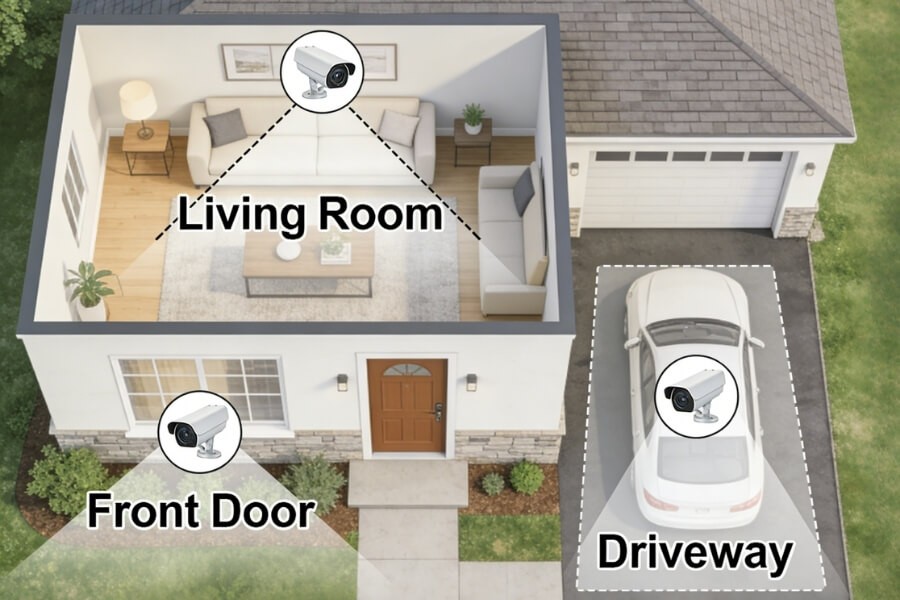
- A living room requires wide coverage
- A front door requires clear facial detail
- A driveway may require both
Clear goals help you avoid choosing the wrong lens from the start.
How Wide Should Your Camera View Be
Field of view determines how much area your camera can capture.
There are two main options:
- Wide view – covers more area, but with less detail
- Narrow view – covers less area, but captures more detail
Typical use cases:
- Wide view – rooms, open spaces, parking areas
- Narrow view – entrances, hallways, long-distance monitoring
Please note that a wider view can make faces or objects harder to identify at a distance. In most home setups, a balance between coverage and detail is more practical than choosing the widest possible view.
How to Choose the Right Lens Size (mm)
Focal length, measured in millimeters, directly affects both field of view and detail.
Basic rule:
- Smaller focal length → wider view
- Larger focal length → narrower view with more detail
Common options:
- 2.8mm – wide coverage, suitable for indoor rooms
- 4mm – balanced option for entrances and small offices
- 6mm – suitable for hallways or mid-range monitoring
- 8mm–12mm – suitable for long-distance viewing
In most residential scenarios, a 2.8mm or 4mm lens provides sufficient coverage without sacrificing usability. If you are unsure, starting with a wider lens reduces the risk of blind spots.
Fixed vs Varifocal Lens – Which One Fits Your Setup
Once you understand your field of view, choose how much flexibility you need.
Fixed Lens
- Fixed viewing angle
- Simple setup and stable performance
- Suitable for consistent monitoring areas
Common use:
- Indoor rooms
- Entry points
- Offices
Varifocal Lens
- Adjustable focal length
- Allows fine-tuning during installation
- Suitable when the exact viewing angle is uncertain
Motorized Zoom
- Remote adjustment via app or software
- Common in PTZ or commercial systems
If your monitoring area does not change, a fixed lens is usually sufficient. If you expect adjustments during setup or operation, a varifocal lens is a suitable option.
How Lighting Affects Your Camera Lens Choice
Lighting conditions directly affect image clarity, especially at night.
Aperture is measured using F-numbers:
- Lower F-number → more light enters the lens
- Higher F-number → less light, but deeper focus
Practical guidance:
- Low-light environments – choose a larger aperture such as F1.6
- Stable indoor lighting – standard aperture is sufficient
Many modern security cameras include automatic light adjustment. This helps maintain consistent exposure when lighting conditions change throughout the day.
Make Sure the Lens Works with Your Camera
Lens compatibility ensures a complete and undistorted image.
Sensor Size
- The lens should support the same or larger sensor size than the camera
- Mismatch can cause dark edges or reduced field of view
Mount Type
- Common types include C-mount and CS-mount
- Most residential cameras use built-in lenses, so manual matching is not required
Please note that compatibility is more relevant for modular or commercial systems than for standard home cameras.
Best Lens Choices for Common Monitoring Scenarios
Use these examples to simplify your decision.
Indoor Home Monitoring
- Distance: 3–5 meters
- Goal: cover the entire room
Recommended:
- 2.8mm or 4mm fixed wide-angle lens
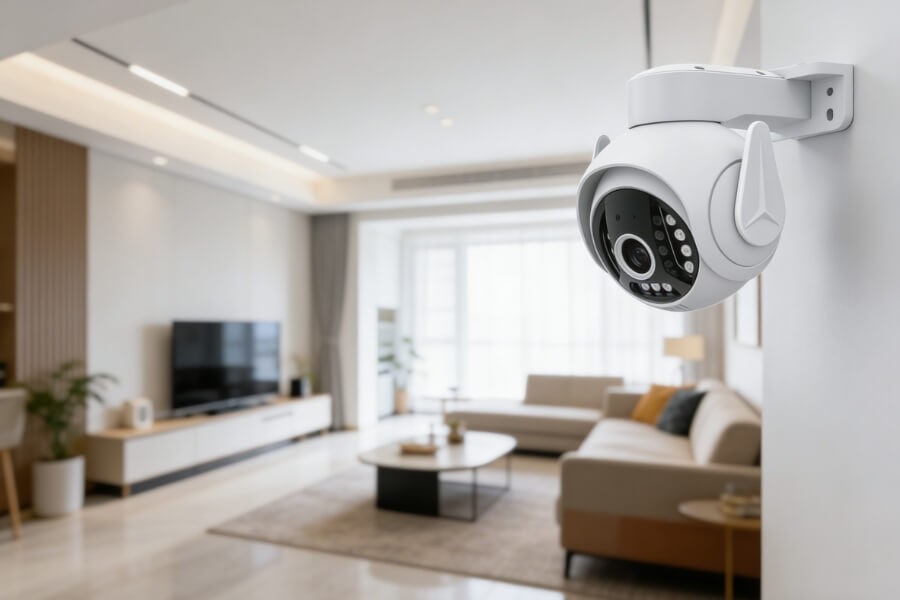
If you are using a Wi-Fi camera with pan-tilt support, a wide-angle lens can provide full coverage without repositioning. This type of setup is commonly used in home monitoring cameras designed for simple indoor installation.
Small Office or Retail Store
- Goal: monitor entrances and activity areas
Recommended:
- 4mm or varifocal lens (2.8–12mm)
This allows adjustment during installation to balance coverage and detail.
Outdoor or Yard Monitoring
- Lighting: variable
- Distance: medium to long
Recommended:
- 6mm or higher focal length
- Lens with strong low-light performance
A larger aperture helps maintain visibility at night or in changing light conditions.
Long-Distance or Narrow Areas
- Example: hallway, driveway
Recommended:
- 8mm or higher focal length
This improves detail capture at a distance but reduces overall coverage. It is important to position the camera carefully to avoid missing side areas.
Common Lens Selection Mistakes to Avoid
Choosing the wrong lens can reduce performance even if the camera has high resolution.
Avoid these common mistakes:
- Using a wide lens when detail is required → faces and objects appear too small
- Using a narrow lens for large areas → blind spots increase
- Ignoring lighting conditions → poor night visibility
- Choosing incompatible lens and sensor sizes → image distortion or dark edges
Understanding these trade-offs helps reduce the need for repositioning or replacing equipment later.
Do You Really Need to Calculate Focal Length
In most home or small business setups, exact calculation is not necessary.
However, if you need precise coverage, focal length can be estimated based on:
- Distance to the subject
- Desired viewing width
- Sensor size
For general use, selecting a standard focal length based on common scenarios is usually sufficient.
FAQ
What is the difference between a 2.8mm and 4mm lens?
A 2.8mm lens provides a wider field of view, making it suitable for covering entire rooms or open areas. A 4mm lens offers a narrower view but captures more detail at a slightly longer distance. For most home use, 2.8mm prioritizes coverage, while 4mm provides a better balance between range and clarity.
Should I choose a fixed or varifocal lens?
A fixed lens is suitable for stable environments where the viewing angle does not need to change after installation. A varifocal lens allows adjustment of the focal length, which is useful when the exact field of view is uncertain. It is commonly used in setups where flexibility is required during installation or monitoring.
Is a larger aperture always better?
A larger aperture allows more light to enter the lens, which improves image brightness in low-light conditions. However, it also reduces depth of field, which may cause parts of the scene to appear less sharp. For most residential security cameras, an aperture between F1.6 and F2.0 provides a practical balance.
Do home security cameras require lens compatibility checks?
Most home security cameras use built-in lenses, so users do not need to check compatibility between the lens and sensor. Compatibility becomes important in professional or modular systems where lenses can be replaced. In those cases, mismatched components may result in reduced image quality or dark edges.
Can one lens cover all scenarios?
No single lens can perform well in all situations. Wide-angle lenses are better for covering large areas, while longer focal lengths are better for capturing detail at a distance. Choosing the right lens depends on your monitoring goal, including coverage area, distance, and lighting conditions.
Final Thoughts
Choosing the right security camera lens starts with understanding your monitoring goal. Field of view, focal length, and lighting conditions are the most important factors.
For most users, a wide-angle fixed lens combined with simple installation and flexible viewing features can meet everyday monitoring needs. Systems designed for home use often integrate these features to reduce setup complexity and improve usability.
By focusing on real-world requirements rather than specifications alone, you can select a security camera lens that delivers clear and reliable performance in daily use.