Outdoor Light Camera Solutions for Safer Night Security
Why Outdoor Light Cameras Improve Night Security
Outdoor areas are often the weakest points in home security. Front doors, driveways, and backyards are exposed and usually poorly lit at night.
A standard outdoor security camera may record activity, but low light reduces usable detail. Faces, movement, and vehicle information may not be clear enough to act on.
An outdoor light camera improves both visibility and response. It lights up the area when motion is detected and makes activity easier to identify while also discouraging unwanted access.
What an Outdoor Light Camera Does and Why It Matters
An outdoor light camera combines a surveillance camera with a motion-activated light.
It helps in two practical ways:
- It improves night footage by illuminating the scene when activity occurs
- It signals presence through visible lighting, which can reduce unwanted behavior
Unlike traditional cameras, it does not depend on external lighting conditions to capture clear footage at night.
Which Outdoor Light Camera Type Should You Use
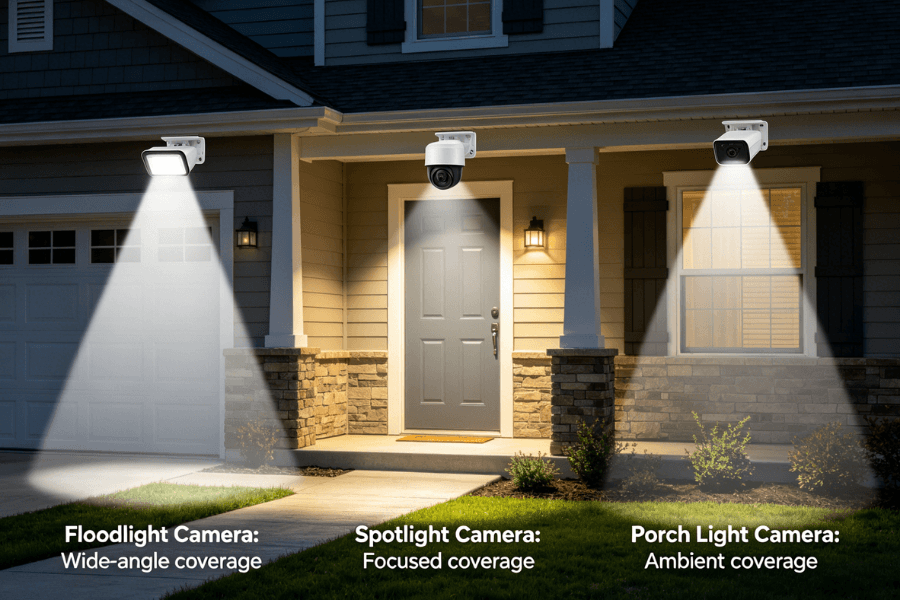
Floodlight cameras
Floodlight cameras are designed for wide outdoor coverage.
They are commonly used for:
- Driveways where vehicle movement needs to be tracked
- Backyards where visibility is limited
- Open areas that require strong lighting at night
If you need to monitor a large space and capture movement across a wide field, a floodlight security camera is more effective.
Spotlight cameras
Spotlight cameras focus on smaller, high-traffic areas.
They are suitable for:
- Front doors where visitors need to be identified
- Entry points such as side doors or pathways
- Narrow spaces where strong lighting is not necessary
If your goal is to recognize faces or interactions at close range, a spotlight camera provides more controlled illumination.
Porch light cameras
Porch light cameras integrate surveillance into standard lighting fixtures.
They are useful when:
- You want monitoring without making the camera obvious
- You prefer a setup that blends into existing exterior lighting
This approach works well in residential environments where appearance matters.
Where to Place Outdoor Light Cameras for Better Coverage
Placement determines how effective your system will be. Even a high-quality outdoor camera with light can underperform if installed incorrectly.
Use these placement strategies:
- Front door – A spotlight camera helps capture clear visitor details without excessive brightness
- Driveway – A floodlight camera improves visibility for vehicles and wider movement
- Backyard – A wide-angle or floodlight setup reduces blind spots in open areas
- Garage or side entrance – A compact camera can monitor narrow access points
- Porch lighting area – A porch light camera adds discreet coverage
Important
Avoid pointing cameras directly at reflective surfaces such as walls or glass. This can cause glare when the light activates and reduce image clarity.
For example, wide outdoor areas often benefit from cameras designed for broader coverage and stronger lighting. Some outdoor camera systems are built to simplify this type of setup without requiring complex installation.
What Features Matter in Real Outdoor Use
Not all specifications translate to better real-world performance. Focus on how each feature affects your setup.
Resolution and image clarity
If you need to identify faces or license plates, higher resolution helps reduce blur when the light activates.
- 2MP or 3MP works for general awareness
- 4MP or higher improves detail in larger or more active areas
Lighting control and night visibility
Lighting should respond to activity rather than stay on continuously.
Look for:
- Motion-triggered lighting
- Adjustable brightness levels
- Support for color night footage
This helps maintain visibility without unnecessary exposure or energy use.
Motion detection accuracy
Frequent false alerts reduce the usefulness of your system.
Choose cameras that:
- Distinguish between people, vehicles, and general movement
- Allow you to define detection zones
- Offer sensitivity adjustments
This is especially important in outdoor environments with constant motion.
Weather resistance
Outdoor cameras must remain reliable in changing conditions.
Select devices with:
- At least IP65 protection
- Stable operation across seasonal temperature changes
This ensures consistent monitoring throughout the year.
Power and connectivity
Your setup will depend on available power and network conditions.
- Battery or solar-powered cameras allow flexible placement
- Wired cameras provide stable, continuous operation
If you are using a wireless outdoor camera system, a stable WiFi connection is important for real-time alerts and video access.
Common Outdoor Camera Problems and Fixes
Outdoor light cameras improve security, but incorrect setup can lead to issues.
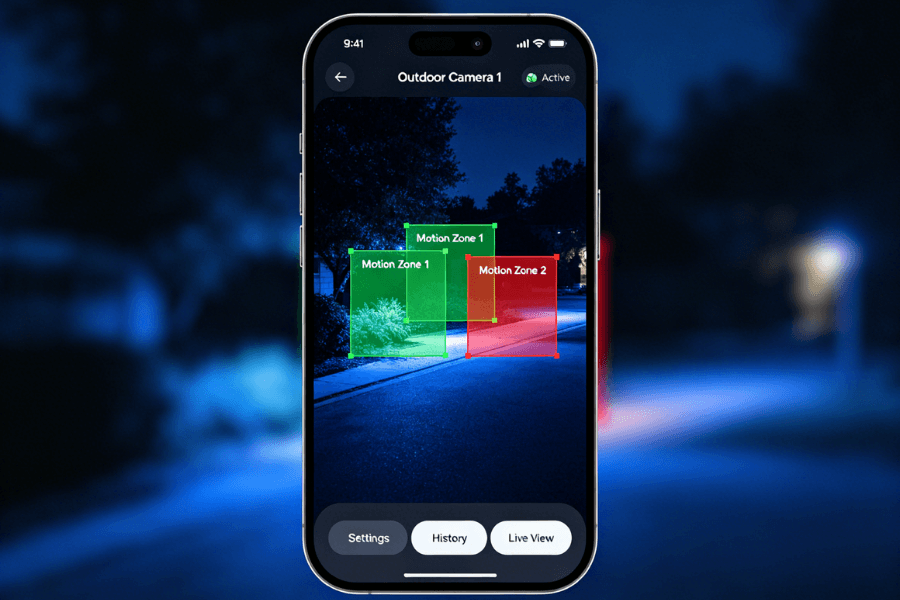
Why does my outdoor camera light turn on randomly
Wind, insects, or passing shadows can trigger motion detection.
To reduce this:
- Adjust detection sensitivity
- Set specific detection zones
- Use smart detection features when available
Why is my night footage too bright or unclear
Strong lighting can cause overexposure.
To fix this:
- Lower brightness settings
- Adjust the angle to avoid direct reflection
Why is my outdoor camera connection unstable
Distance from the router or physical obstacles can weaken the signal.
To improve stability:
- Install cameras within WiFi coverage
- Use a WiFi extender if needed
Why does my camera miss important activity
Incorrect positioning may create blind spots.
To improve coverage:
- Install at a slight downward angle
- Avoid placing the camera too high above the target area
How to Choose the Right Outdoor Light Camera for Your Home
The right outdoor camera with light depends on your environment and usage.
Use this decision process:
- Define the coverage area
- Choose a power method
- Determine your monitoring goal
- Evaluate smart features
If you are building a complete system, combining outdoor cameras with indoor monitoring can improve overall coverage. For example, some setups use wireless indoor cameras alongside outdoor units to create a more consistent home monitoring system without complex wiring.
Where Outdoor Light Cameras Work Best
Outdoor light cameras are most effective when used in practical, everyday scenarios.
- Monitoring deliveries at entry points
- Observing movement in backyards
- Tracking vehicles in driveways
- Securing side entrances and less visible areas
- Improving visibility around garages
These situations show how lighting and monitoring work together to improve awareness and response.
Choosing the Right Setup for Your Outdoor Security
Outdoor light cameras combine lighting, monitoring, and deterrence into a single system.
A good setup depends on placement, lighting behavior, and detection accuracy rather than a single specification. Matching the camera type to the location is more important than choosing the highest resolution.
If you are planning a full home setup, combining outdoor lighting cameras with indoor monitoring systems can provide more consistent coverage. Solutions such as RusinVision camera systems are often used to simplify both indoor and outdoor monitoring while keeping installation straightforward.
FAQ
Should outdoor light cameras stay on all night?
No. Most outdoor light cameras use motion-activated lighting rather than continuous illumination. The light turns on only when movement is detected, which helps conserve energy and reduces unnecessary brightness. This setup also makes alerts more noticeable, since lighting changes are tied to actual activity instead of staying constant throughout the night.
Why does my outdoor camera light turn on randomly?
Outdoor camera lights may activate due to environmental factors such as wind, insects, passing cars, or shifting shadows. These triggers are often detected as motion. To reduce this, adjust detection sensitivity, define motion zones, and enable smart detection features that focus on people or vehicles instead of general movement.
How long do battery-powered outdoor cameras last?
Battery life usually ranges from one to six months depending on usage conditions. Cameras placed in high-traffic areas will trigger more often and consume more power. Using solar panels or reducing motion sensitivity can help extend battery life and maintain more stable operation over time.
Are wired floodlight cameras difficult to install?
Wired floodlight cameras require connection to an existing power source, often replacing an outdoor light fixture. Installation may involve handling electrical wiring, so it is recommended to use a qualified electrician if you are not familiar with electrical work. This type of setup provides more consistent power compared to battery-based systems.
Can outdoor cameras with lights work without a subscription?
Yes. Many outdoor cameras support local storage through microSD cards or network video recorders. Basic recording and live viewing functions usually work without a subscription. Paid plans may provide additional features such as cloud storage, advanced detection, or extended video history.
How can I improve outdoor camera detection accuracy?
Detection accuracy can be improved by adjusting motion sensitivity, setting specific detection zones, and positioning the camera correctly. Cameras that support human or vehicle recognition can further reduce false alerts. Proper placement, such as avoiding moving trees or busy roads, also helps improve overall detection performance.